TsunamiSimulator
    
A scientifically grounded 3D-globe desktop application for simulating tsunami generation, propagation, and coastal inundation from asteroid impacts, nuclear detonations (atmospheric and underwater), seafloor earthquakes, and subaerial landslides — with peer-reviewed historical presets like Chicxulub (66 Ma), Tōhoku 2011, Indian Ocean 2004, and Lituya Bay 1958.
This is the NukeMap for tsunamis — but with a real 3D bathymetric globe, real shallow-water physics, and presets you can scrub through frame-by-frame.
Visual tour
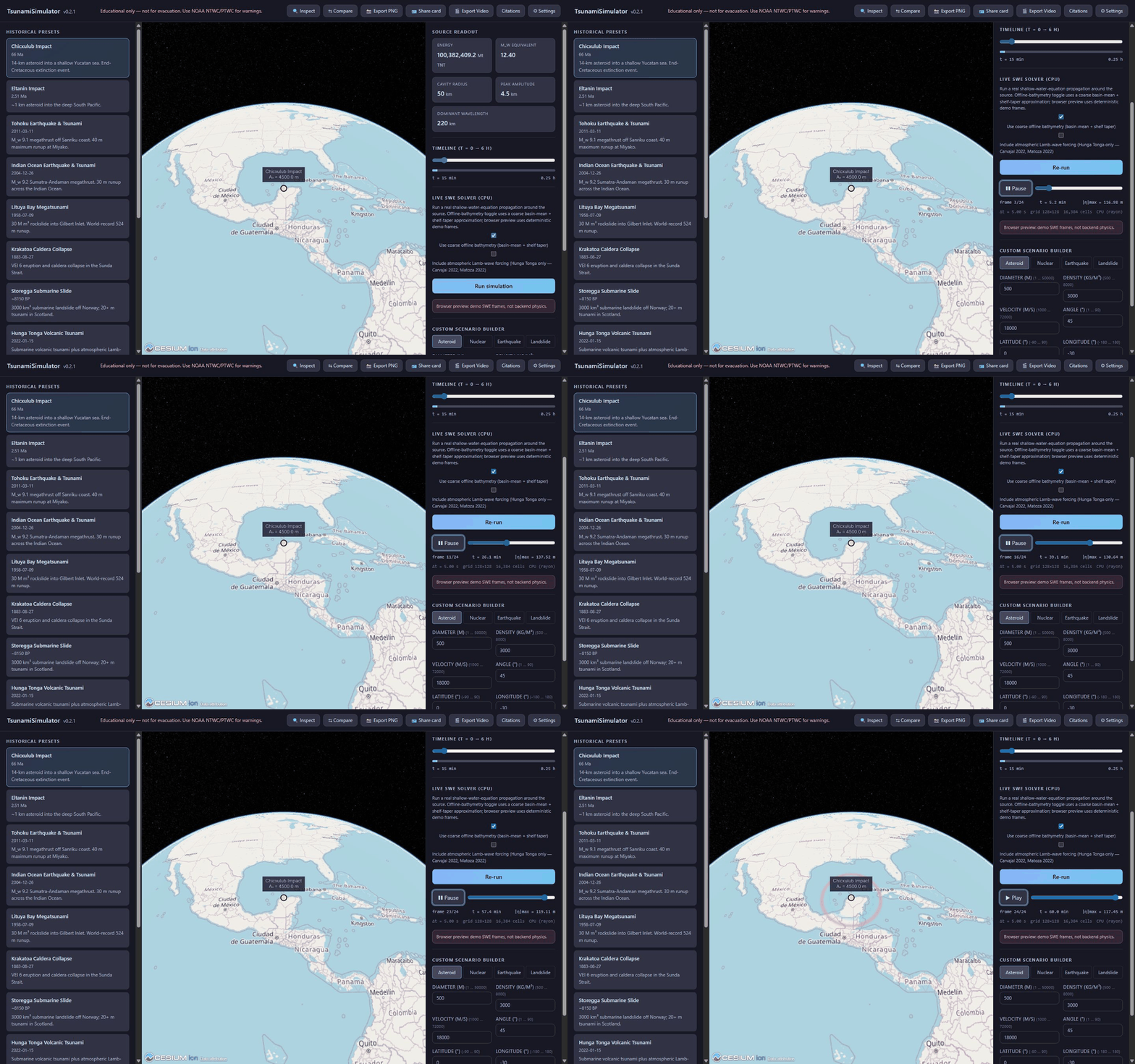
| Historical preset + source readout | Live SWE playback |
|---|---|
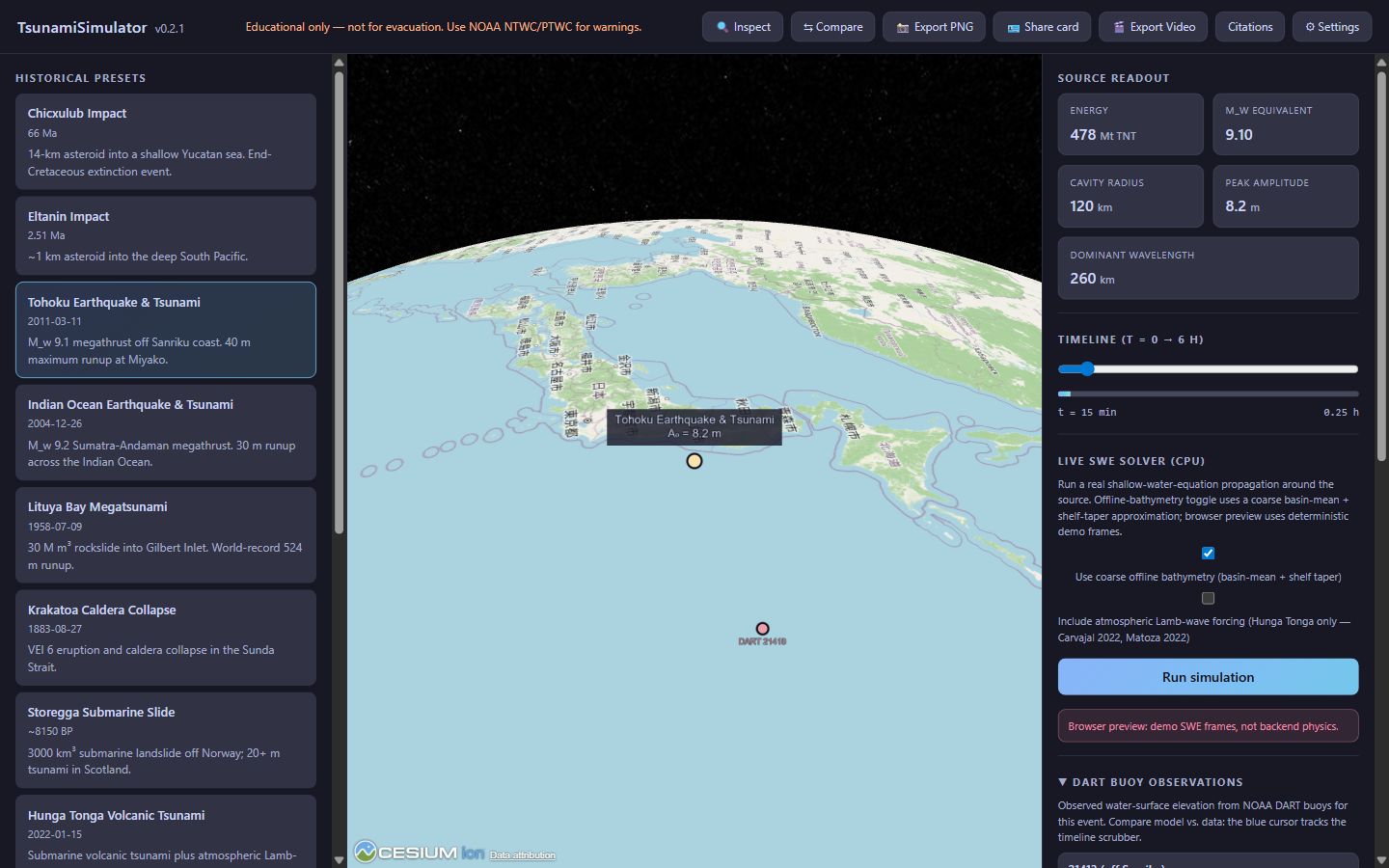 |
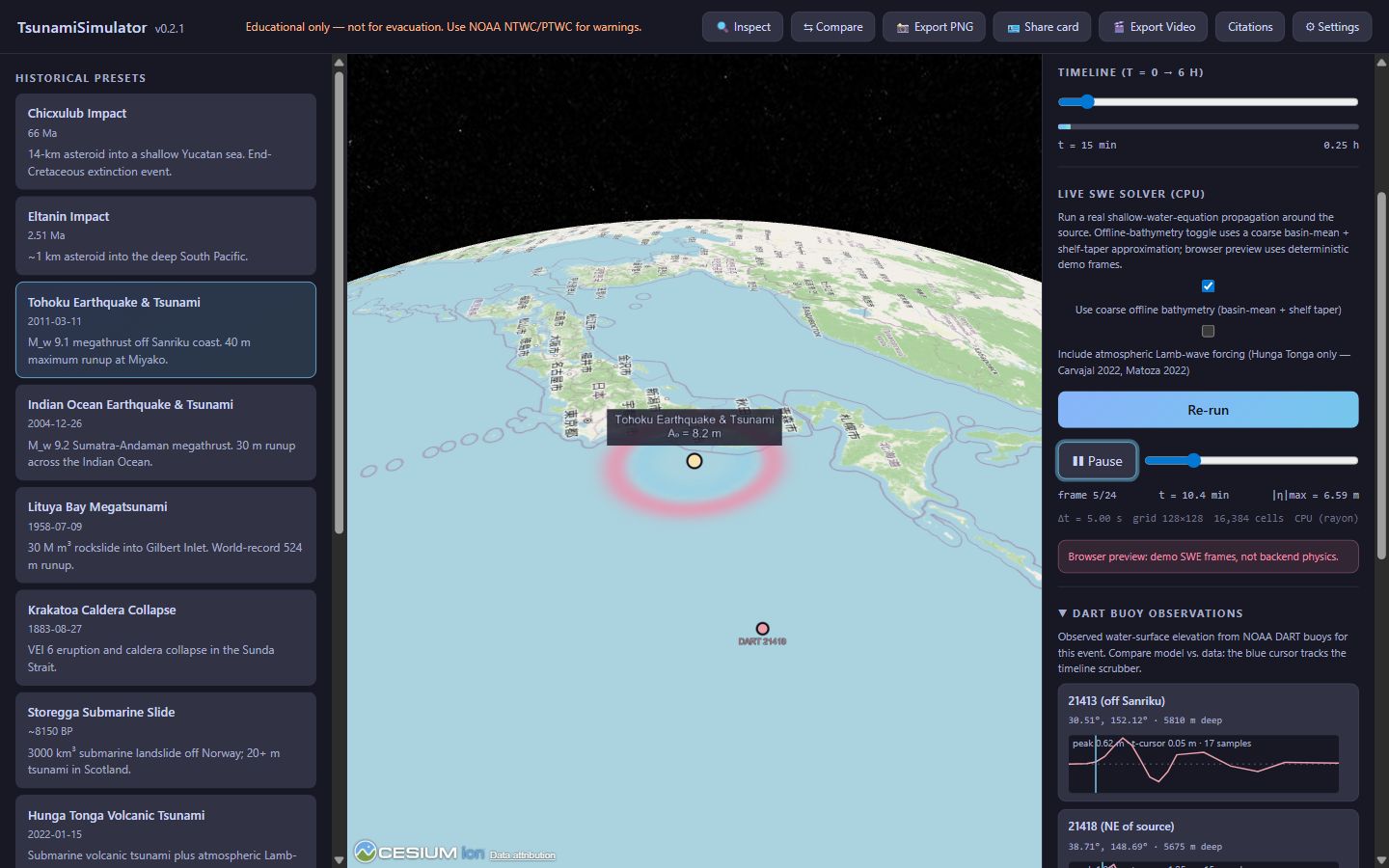 |
| Side-by-side comparison | Scenario builder + globe pick | Citations |
|---|---|---|
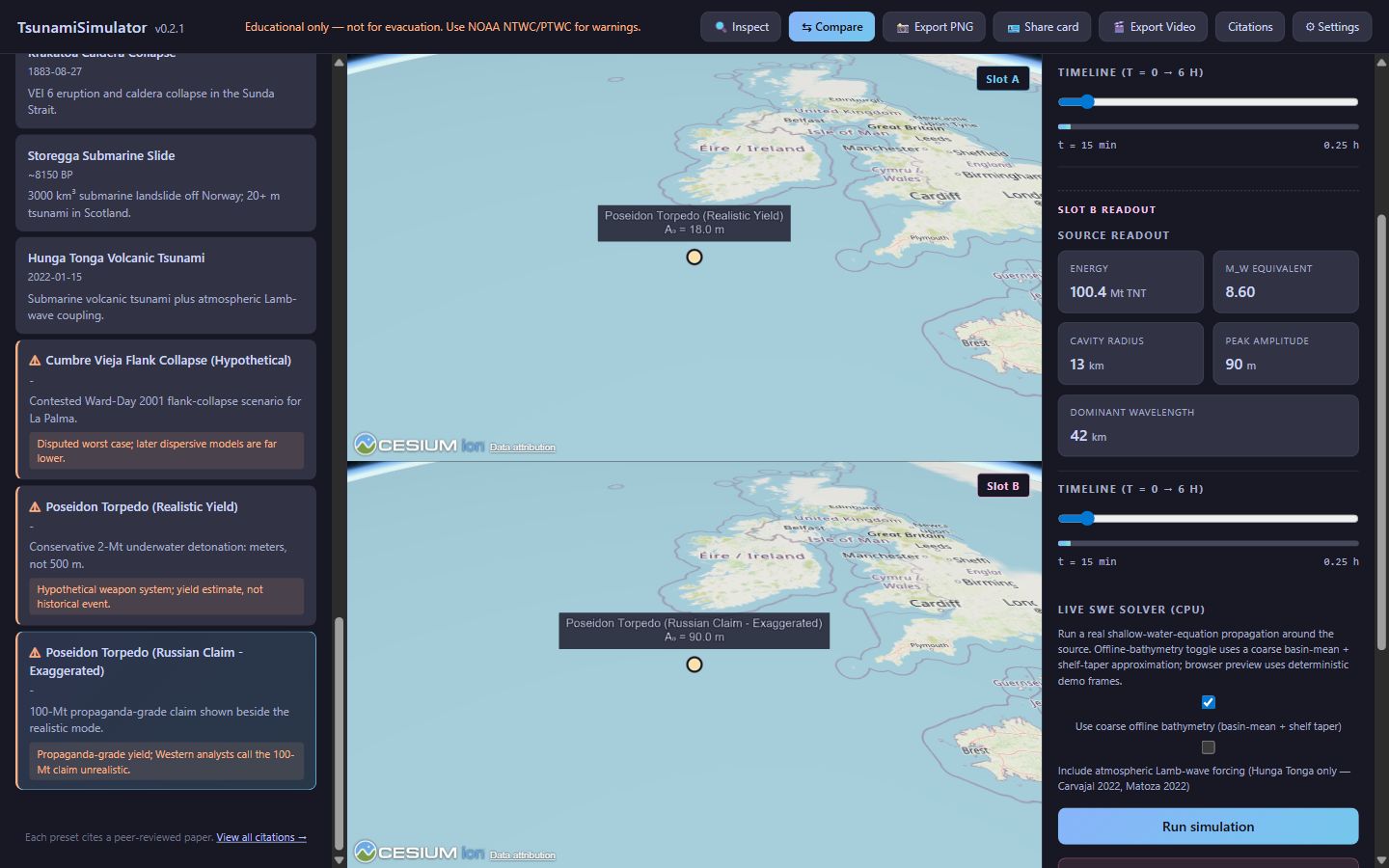 |
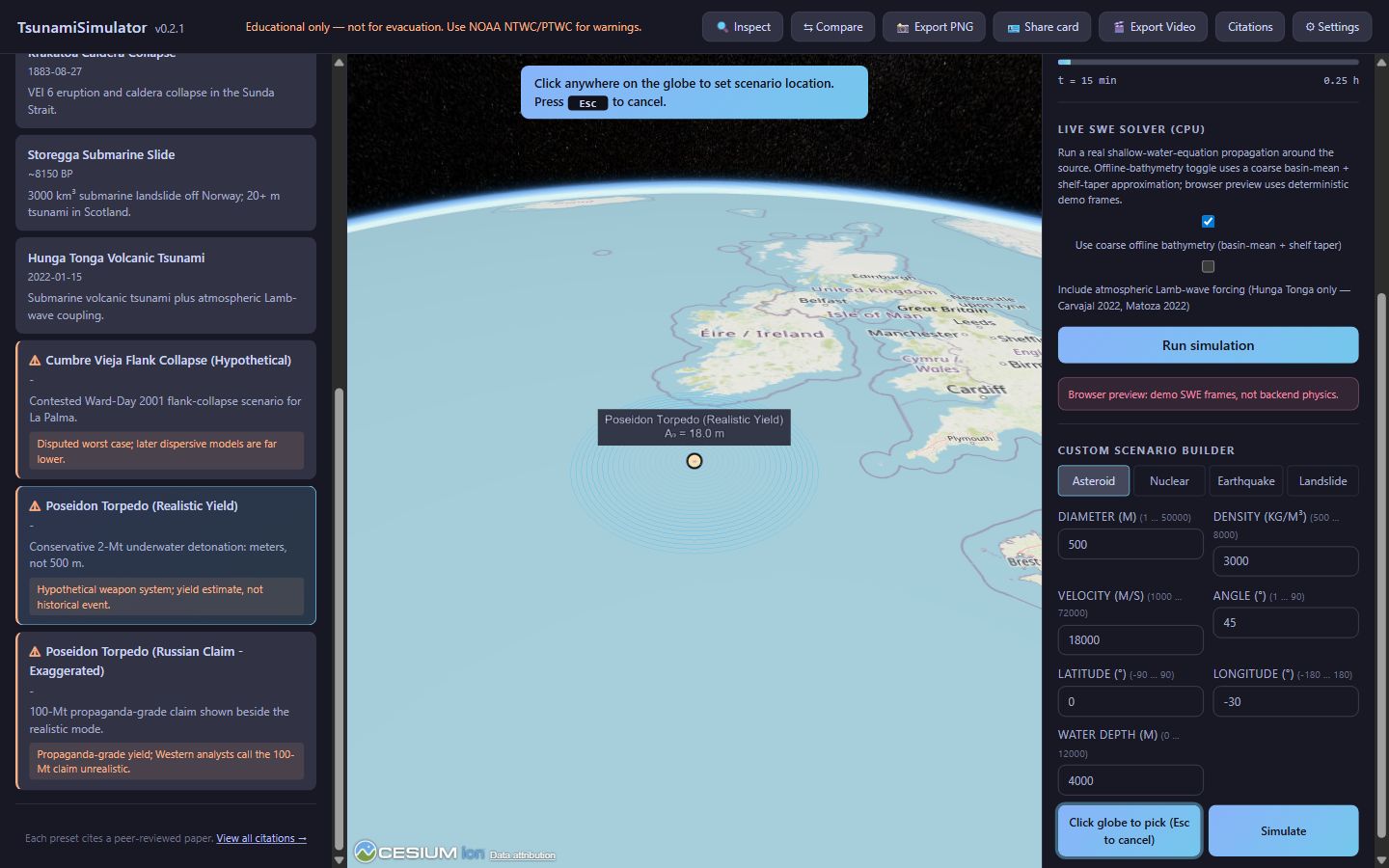 |
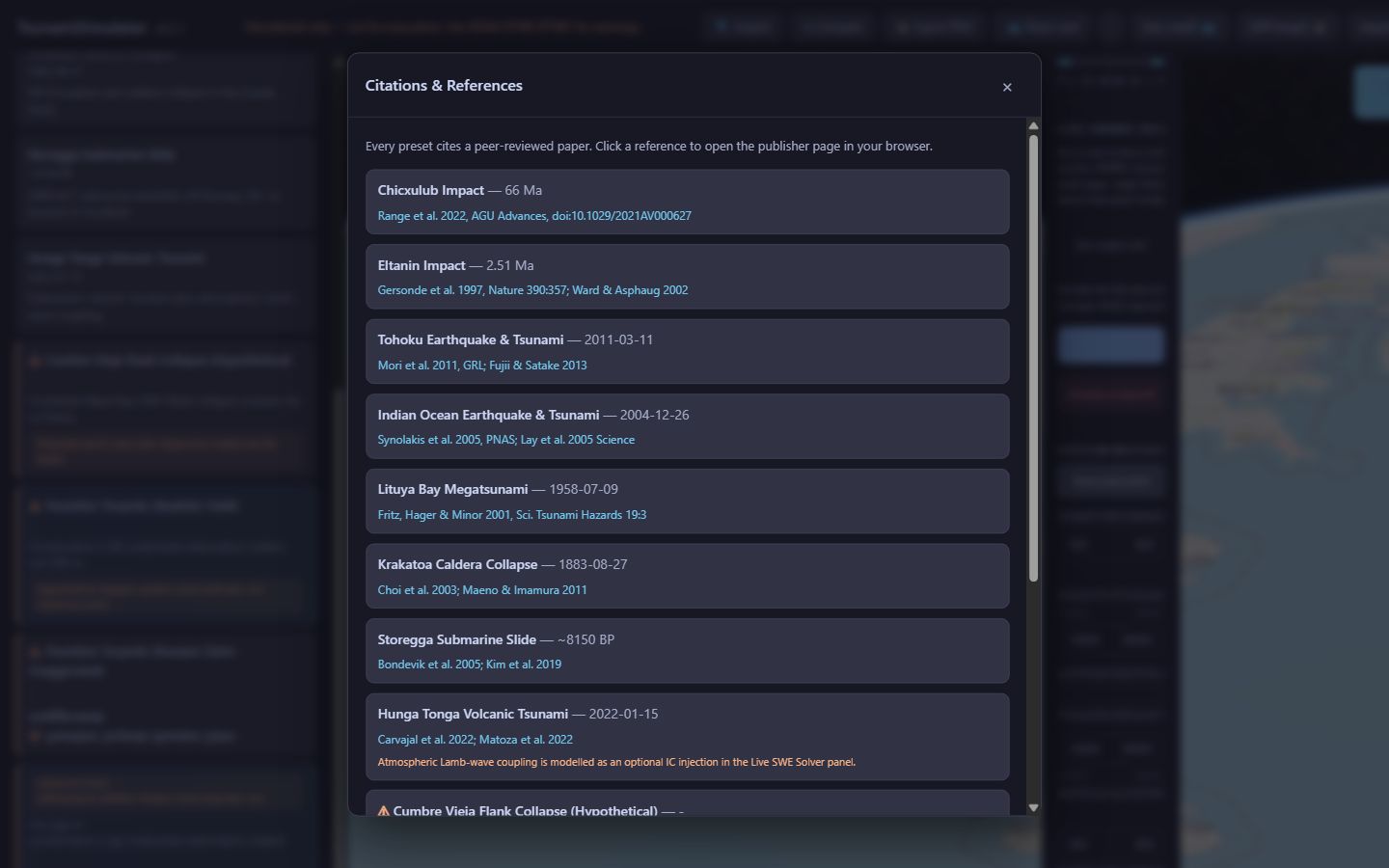 |
Why this exists
Existing tools each do one piece:
- NukeMap — nuclear airburst effects only, 2D map, no water.
- Asteroid Launcher — fun, 2D map, no propagating tsunami.
- Purdue "Impact: Earth!" — accurate formulas, single-point readout, no animation.
- GeoClaw / COMCOT / MOST — operational accuracy, Fortran/Python, no consumer UI.
TsunamiSimulator combines them: NOAA-grade physics + consumer-grade interactive globe. Pick a source (asteroid, nuke, fault, slide), drop it anywhere on Earth, and watch a real shallow-water solution propagate over GEBCO bathymetry, run up real coastlines, and produce inundation polygons.
Features (current build + roadmap)
Source models (energy → initial water-surface displacement)
| Source | Status | Reference |
|---|---|---|
| Asteroid / comet impact | ✅ formulas wired | Ward & Asphaug 2000 Icarus 145:64; Schmidt & Holsapple 1982 |
| Underwater nuclear | ✅ formulas wired | Glasstone & Dolan 1977; Le Méhauté 1996; DNA 1996 (5% energy → wave) |
| Atmospheric / surface nuclear (ocean) | ✅ formulas wired | Van Dorn et al. 1968; Adams 1972 |
| "Russia Poseidon" tsunami torpedo | ✅ realistic mode | Skeptical physics — 360° dispersion, ~5% efficiency |
| Earthquake (Okada fault dislocation) | ✅ full Okada I-term wired | Okada 1985; Mansinha & Smylie 1971 |
| Subaerial landslide | ✅ Heller–Hager 2D channel | Fritz & Hager 2001 (Lituya); Slingerland & Voight |
| Submarine landslide | ✅ Watts 2003 best-fit | Watts et al. 2005 |
| Volcanic caldera collapse | 🔲 planned | Krakatoa 1883, Hunga Tonga 2022 |
Propagation
- ✅ Linear long-wave (deep-ocean, fast preview).
- ✅ Shallow-water equations — depth-averaged 2D leapfrog with
rayonrow-parallel updates, Manning bottom friction, CFL-safe Δt, snapshots rendered as PNG overlays on the Cesium globe. - 🔲 Boussinesq for dispersive waves (impact-tsunami wavelengths shorter than ocean depth — important for Ward–Asphaug regime).
- 🔲 Adaptive mesh refinement (AMR) like GeoClaw — coarse far-field, fine coastal.
- ✅ GPU compute via
wgpubehind thegpufeature flag, with CPU fallback when no adapter is available.
Coastal inundation
- ✅ Synolakis 1987 runup law sampled at 60+ named coastal points, rendered as colour-graded 3D bars on the globe.
- 🔲 MOST-style wetting/drying on bathymetric grid.
- ✅ First-order inundation discs from runup/slope estimates.
- 🔲 Real flood polygons rendered as GeoJSON overlays on Cesium.
Presets (historical events with peer-reviewed parameters)
| Event | Date | Source type | Magnitude | Peak wave | Reference |
|---|---|---|---|---|---|
| Chicxulub impact | 66 Ma | Asteroid, 14 km dia | ~10⁸ Mt TNT | 4.5 km initial, 1.5 km @ 220 km | Range et al. 2022 AGU Adv |
| Tōhoku | 2011-03-11 | M 9.1 megathrust | — | 40 m runup | Mori et al. 2011 |
| Indian Ocean | 2004-12-26 | M 9.2 megathrust | — | 30 m runup, 230k dead | Synolakis et al. 2005 |
| Lituya Bay | 1958-07-09 | Rockslide, 30 M m³ | M 7.8 trigger | 524 m runup | Fritz et al. 2001 |
| Krakatoa | 1883-08-27 | Caldera collapse | VEI 6 | 42 m | Choi et al. 2003 |
| Storegga slide | ~8150 BP | Submarine slide, 3000 km³ | — | 20 m+ in Scotland | Bondevik et al. 2005 |
| Hunga Tonga | 2022-01-15 | Submarine volcano | VEI 5–6 | 15 m local + atmospheric Lamb wave | Carvajal et al. 2022 |
| Eltanin | 2.51 Ma | Asteroid, ~1 km dia | South Pacific | Globally significant | Gersonde et al. 1997 |
| Hypothetical Cumbre Vieja | — | Flank collapse (La Palma) | 500 km³ scenario | Disputed; 5–25 m E coast US | Ward & Day 2001 (controversial) |
| "Poseidon" deployment | — | 100 Mt underwater | — | ~1–5 m at 100 km (realistic) | DNA 1996, Glasstone 1977 |
UX
- 5 globe styles: OpenStreetMap (default, no token), Esri World Imagery, Natural Earth II (offline), Cesium World Imagery, Cesium World Bathymetry.
- Scenario builder — tabbed Asteroid / Nuclear / Earthquake / Landslide forms; click-globe-to-pick location.
- Timeline scrubber + SWE playback — scrub a 24-frame snapshot sequence through the live shallow-water solver.
- Effect overlays — wavefront ring, coastal runup bars at 60+ named coastal points, DART buoy historical observations for the three modern presets.
- Side-by-side comparison mode — two scenarios on synchronised globes.
- Catppuccin Mocha dark theme default + Latte light theme toggle.
Install
Prebuilt installers for the latest release are on the
Releases page —
Windows (.msi, .exe), macOS universal (.dmg), and Linux
(.AppImage, .deb, .rpm).
The app launches on the no-token OpenStreetMap globe by default and is fully usable out of the box. A free Cesium ion token (optional) unlocks high-resolution satellite imagery + GEBCO bathymetric terrain from the Settings dialog.
Build from source
Prerequisites:
- Node.js ≥ 20 LTS
- Rust ≥ 1.78 (stable) with
rustup - Windows: Visual Studio 2022/2026 with "Desktop development with C++"
workload (provides MSVC
link.exe); WebView2 runtime (preinstalled on Win11) - macOS: Xcode Command Line Tools
- Linux:
libwebkit2gtk-4.1-dev,libgtk-3-dev,libayatana-appindicator3-dev,librsvg2-dev,libsoup-3.0-dev
The Tauri CLI ships via the @tauri-apps/cli npm dev dependency — no
separate cargo install step.
git clone https://github.com/SysAdminDoc/TsunamiSimulator
cd TsunamiSimulator
npm install
npm run dev                # browser preview with deterministic demo data
npm run tauri dev          # full desktop app with Rust/Tauri IPC
npm run tauri build        # platform installer(s) in src-tauri/target/release/bundle/
To bake a Cesium ion token at build time, cp .env.example .env and paste
it in; otherwise leave it blank and paste at runtime in Settings.
Architecture
┌─────────────────────────── Tauri 2 Window ───────────────────────────┐
│ ┌─────────────────────────────────────────────────────────────────┐  │
│ │  React 19 + TypeScript + Vite (frontend / WebView2)             │  │
│ │  ─ CesiumJS 1.124+ globe with GEBCO bathymetry                   │  │
│ │  ─ Scenario builder, timeline, overlays, results panel           │  │
│ └──────────────────────────────  ▲  ───────────────────────────────┘  │
│                                  │ tauri::invoke (JSON over IPC)      │
│ ┌──────────────────────────────  ▼  ───────────────────────────────┐  │
│ │  Rust backend (src-tauri/)                                       │  │
│ │  ─ physics::asteroid    Ward–Asphaug + Schmidt–Holsapple         │  │
│ │  ─ physics::nuclear     Glasstone–Dolan + Le Méhauté             │  │
│ │  ─ physics::landslide   Fritz–Hager + Slingerland–Voight         │  │
│ │  ─ physics::earthquake  Okada 1985 (planned)                     │  │
│ │  ─ physics::shallow_water  NSWE + Synolakis runup                │  │
│ │  ─ data::bathymetry     GEBCO 15-arcsec sampler                  │  │
│ │  ─ presets              Chicxulub / Tōhoku / Lituya / …          │  │
│ └──────────────────────────────────────────────────────────────────┘  │
└───────────────────────────────────────────────────────────────────────┘
Heavy physics runs in the Rust backend (multi-threaded via rayon, GPU via wgpu planned). The frontend only handles globe rendering, controls, and result visualization. The IPC boundary keeps the WebView from blocking on million-cell SWE solves.
The science (and its limits)
This is not a forecast tool. Compared to operational models like NOAA MOST:
- What's accurate — initial conditions (cavity geometry from Ward–Asphaug, fault displacement from Okada), open-ocean propagation in deep water, far-field arrival times.
- What's approximate — coastal runup (we use Synolakis 1987 analytical instead of full wetting/drying), dispersion (linear long-wave first, Boussinesq later).
- What's wrong — anything involving the atmosphere coupling (Hunga Tonga–style Lamb-wave coupling is a research frontier), tsunami earthquake source-time functions (we use static dislocation), submarine landslide rheology.
- The "Russia Poseidon" honest take — Russian state media's 500-m-wave claim is propaganda. The 1996 Defense Nuclear Agency study put underwater-explosion wave-generation efficiency at ~5%. A 100-Mt warhead at 100 km open ocean produces a ~few-meter wave, not a city-killer. We model both the propaganda yield and a realistic one — the comparison is the point.
See `docs/science/` for formula derivations and citations.
Citations (anchors, full list in docs/science/REFERENCES.bib)
- Ward, S. N., & Asphaug, E. (2000). Asteroid impact tsunami: a probabilistic hazard assessment. Icarus, 145, 64–78.
- Range, M. M., et al. (2022). The Chicxulub Impact Produced a Powerful Global Tsunami. AGU Advances. https://doi.org/10.1029/2021AV000627
- Synolakis, C. E. (1987). The runup of solitary waves. J. Fluid Mech., 185, 523–545.
- Okada, Y. (1985). Surface deformation due to shear and tensile faults in a half-space. BSSA, 75, 1135–1154.
- Fritz, H. M., Hager, W. H., & Minor, H.-E. (2001). Lituya Bay case: rockslide impact and wave run-up. Sci. Tsunami Hazards, 19, 3–22.
- Glasstone, S., & Dolan, P. J. (1977). The Effects of Nuclear Weapons (3rd ed.). USDOE.
- Le Méhauté, B., & Wang, S. (1996). Water Waves Generated by Underwater Explosion. World Scientific.
- Collins, G. S., Melosh, H. J., & Marcus, R. A. (2005). Earth Impact Effects Program. Meteoritics & Planetary Science, 40, 817–840.
- Berger, M. J., George, D. L., LeVeque, R. J., & Mandli, K. T. (2011). The GeoClaw software for depth-averaged flows. Advances in Water Resources, 34(9), 1195–1206.
Roadmap & research
- `ROADMAP.md` — phased delivery plan (v0.1.0 → v1.0.0).
- `COMPLETED.md` — shipped feature summary.
- `RESEARCH_REPORT.md` — current research synthesis.
- `docs/history/` — archived research plans, including the v0.4.0 forward plan.
License
MIT. For scientific education and hazard-awareness visualization only. Not for evacuation planning. Use NOAA NTWC/PTWC for real warnings.
Author
@SysAdminDoc — Senior Systems Administrator, medical-imaging IT, side projects in physics-based simulators.