



FrameSnap
Browse any video, mark frames visually, and export precise screenshots — all in a dark, polished desktop app.



Features
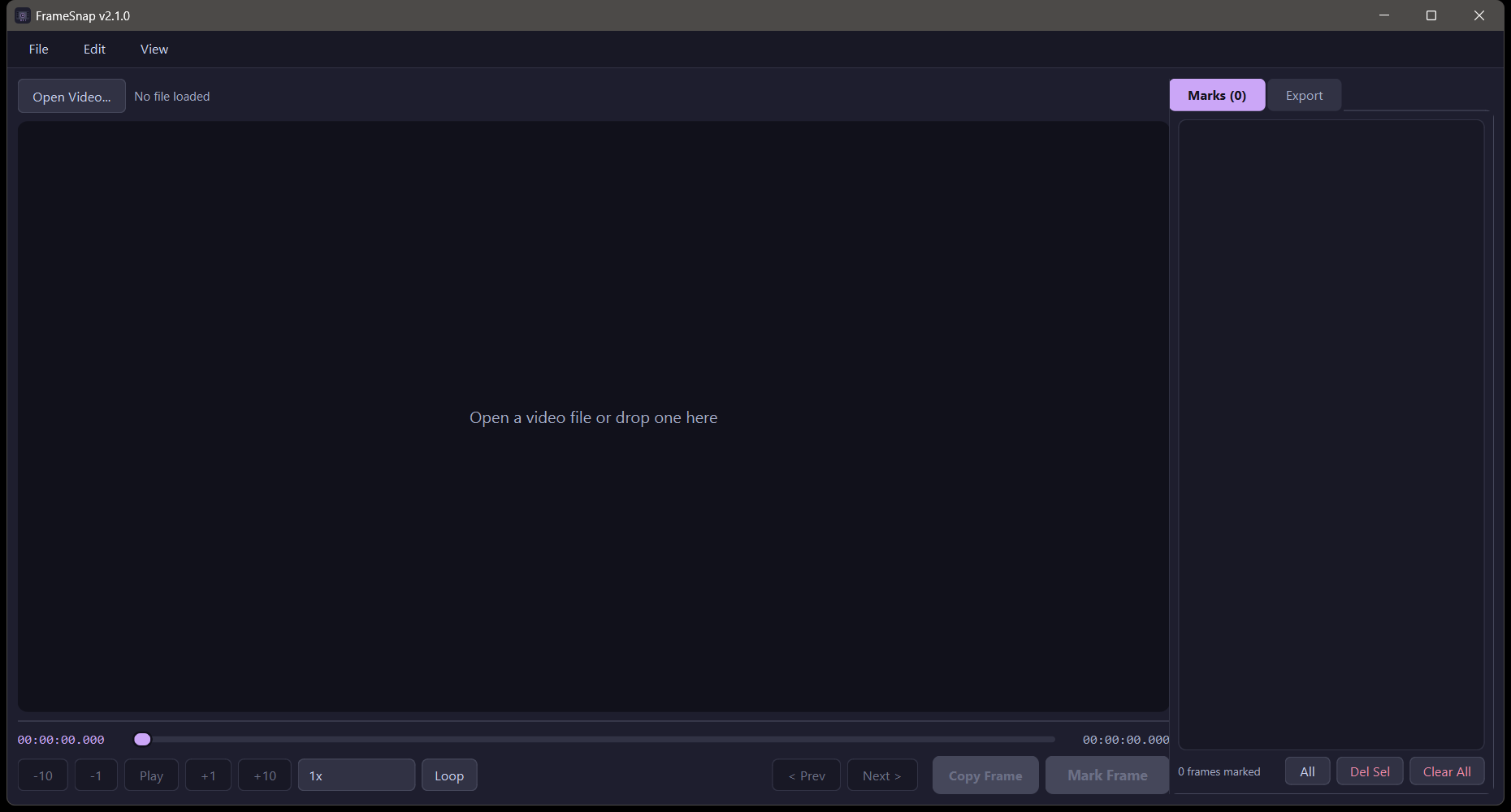
Video Playback
- Open MP4, AVI, MOV, MKV, WMV, FLV, WebM, TS, MTS, M2TS, MXF, OGV, 3GP, VOB, DV, and 30+ other formats
- FFmpeg backend with OS fallback for maximum format compatibility
- Play/Pause with native FPS timing
- Speed control — 0.25x, 0.5x, 1x, 2x, 4x playback speed
- Loop mode — toggle continuous looping during playback
- Step frame-by-frame (-10, -1, +1, +10)
- Drag scrubber to any position
- Mouse wheel on the video to step frames
- Drag-and-drop a video file directly onto the window
- Recent files menu for quick access
Scrubber
- Live hover preview — floating thumbnail with timestamp follows your cursor along the scrubber
- Mark tick indicators — colored ticks drawn directly on the scrubber, each using the mark's assigned color
Frame Marking
- Mark current frame with one click — thumbnail + timestamp added to the Marks panel
- Per-mark colors — right-click any mark to assign a color (Default/Red/Green/Blue/Orange/Yellow/Teal)
- Per-mark labels — right-click any mark to add a custom label (shown in italic)
- Jump to frame from any mark via "Go" button or right-click menu
- Prev / Next mark navigation buttons for quick cycling
- Multi-select marks with Ctrl/Shift+Click, then bulk delete selected
- Marks are kept sorted by time and persist in sessions
Export
- Formats: PNG (lossless), JPEG, WebP, TIFF, BMP, or animated GIF
- Quality control for JPEG and WebP (1–100%)
- Scale: 100%, 75%, 50%, 25%, or custom pixel width
- Filename template with variables:
{stem}— video filename without extension{frame}— zero-padded frame number (e.g.001234){ts}— timestamp asHH-MM-SS-mmm{label}— custom mark label (ormarkif unset){n}— sequential mark number
- Animated GIF — exports all marked frames as a single looping GIF via Pillow
- Contact Sheet — assembles all marked frames into a single PNG grid with timestamps
- Open Folder button to reveal the export directory in Explorer / Finder
- Copy to Clipboard — copy the current frame or any mark's frame directly
Sessions
- Save Session — stores video path + all marks + labels + colors to a
.fsnapJSON file - Load Session — restores video, marks, labels, and colors from a session file
UX
- Frame overlay on video display — shows frame number, total frames, and timestamp (toggleable via View menu)
- Video info bar — resolution, FPS, duration, frame count, file size shown on load
- Preferences auto-saved (output folder, format, quality, scale, template, overlay state, speed)
- Catppuccin Mocha dark theme throughout
Requirements
- Python 3.10+
- Dependencies are auto-installed on first run:
PyQt6,opencv-python,numpy,Pillow
Installation & Usage
git clone https://github.com/SysAdminDoc/FrameSnap.git
cd FrameSnap
python framesnap.py
On first launch, missing packages are installed automatically via pip. No manual setup required.
Workflow
- Open a video via
File > Open Video..., the button, or drag-and-drop - Scrub the timeline — hover to preview any frame
- Navigate with play, step buttons, or mouse wheel on the video
- Mark frames with the purple Mark Frame button
- Label / color marks via right-click → Edit Label / Set Color
- Switch to the Export tab
- Choose format, quality, scale, and a filename template
- Click Export All Frames (or Contact Sheet... for a grid overview)
Supported Formats
FrameSnap uses OpenCV's FFmpeg backend and accepts any container/codec FFmpeg supports, including:
- Common:
.mp4.mov.avi.mkv.wmv.flv.webm - Transport streams:
.ts.mts.m2ts.m2t - MPEG:
.mpg.mpeg.mpe.m2v.m4v - Professional:
.mxf.dv.y4m - Legacy / Other:
.ogv.3gp.3g2.asf.vob.divx.rm.rmvb.f4v.amv.gif.bik.smk.roq.swf.mjpeg
Keyboard-Free Design
FrameSnap is designed for pure mouse/GUI operation. All actions are accessible through visible controls, right-click context menus, and the menu bar.
License
MIT — see LICENSE